

I. Continuous Batching (连续批处理)
1. Background
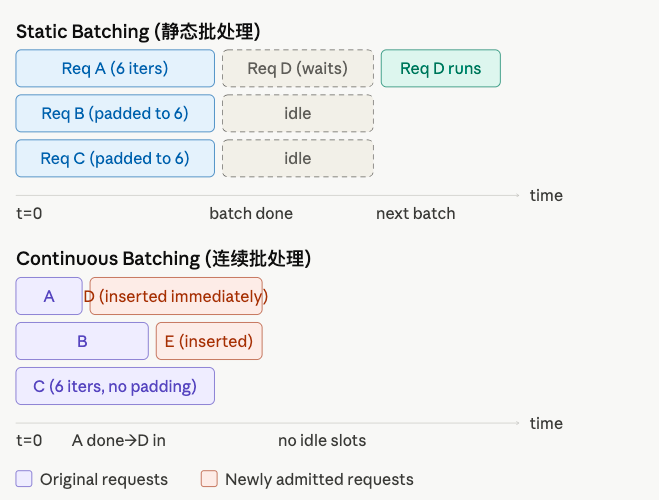
Traditional LLM serving uses static batching (静态批处理): a fixed group of requests is loaded together, the GPU runs until every request in the batch finishes, then the next batch starts. Two problems arise:
- Padding waste (填充浪费): short requests must be padded to match the longest request in the batch, wasting compute.
- Head-of-line blocking (队头阻塞): new requests wait for the entire current batch to complete, even if most slots are already idle.
Continuous Batching (also called iteration-level scheduling, 迭代级调度) solves both by scheduling at the granularity of a single iteration rather than a whole batch.
2. Core Idea
As soon as one request finishes, its GPU slot is freed and a new request is admitted — within the same next iteration.
The scheduler runs once per forward pass (前向传播). It looks at:
- Which running requests still need decode steps.
- Whether any free capacity exists to admit a new prefill request.
This means the batch composition changes every iteration, hence “continuous.”
3. Algorithm
1) Iteration-Level Scheduler (迭代级调度器)
# Standalone simulation of continuous batching.# No external dependencies required.
from collections import deque
class Request: """One inference request (推理请求).""" def __init__(self, req_id: str, prompt_len: int, max_new_tokens: int): self.req_id = req_id self.prompt_len = prompt_len self.max_new_tokens = max_new_tokens self.generated = 0 # tokens generated so far self.prefill_done = False
def is_done(self) -> bool: return self.prefill_done and self.generated >= self.max_new_tokens
def step(self): """Simulate one decode step (解码步骤).""" if not self.prefill_done: self.prefill_done = True # single-step prefill (simplified) else: self.generated += 1
def run_continuous_batching( all_requests: list[Request], max_batch_size: int = 3, max_iterations: int = 20,): waiting_queue = deque(all_requests) # requests not yet admitted running: list[Request] = [] # currently active requests finished: list[Request] = []
for iteration in range(1, max_iterations + 1): # ── 1. Evict finished requests (移除完成的请求) ────────────────── done = [r for r in running if r.is_done()] for r in done: running.remove(r) finished.append(r) print(f" [Done] {r.req_id} finished at iteration {iteration}")
# ── 2. Admit new requests to fill freed slots (补充新请求) ──────── while waiting_queue and len(running) < max_batch_size: new_req = waiting_queue.popleft() running.append(new_req) print(f" [Admit] {new_req.req_id} admitted at iteration {iteration}")
if not running: print(f"Iteration {iteration}: all done.") break
# ── 3. Step every running request (执行一步) ────────────────────── print(f"\n--- Iteration {iteration} | batch={[r.req_id for r in running]} ---") for r in running: r.step()
print("\n=== Summary ===") for r in finished: print(f" {r.req_id}: prompt={r.prompt_len}, generated={r.generated}")
if __name__ == "__main__": requests = [ Request("R1", prompt_len=10, max_new_tokens=2), Request("R2", prompt_len=8, max_new_tokens=5), Request("R3", prompt_len=12, max_new_tokens=3), Request("R4", prompt_len=6, max_new_tokens=2), Request("R5", prompt_len=9, max_new_tokens=4), ] run_continuous_batching(requests, max_batch_size=3)Expected output (abridged):
--- Iteration 1 | batch=['R1', 'R2', 'R3'] --- [Admit] R1 admitted at iteration 1 ...--- Iteration 3 | batch=['R1', 'R2', 'R3'] --- [Done] R1 finished at iteration 4 [Admit] R4 admitted at iteration 4 ← slot freed, new request in immediately--- Iteration 4 | batch=['R2', 'R3', 'R4'] ---...2) Key Invariant (关键不变式)
At every iteration :
where is the maximum batch size (最大批大小), constrained by GPU memory (显存) available for KV Cache (键值缓存).
4. No Padding Needed
In static batching, all sequences in a batch must share the same length tensor, requiring padding tokens (填充令牌):
Static: [A A A A _ _] ← _ = wasted padding [B B _ _ _ _] [C C C C C C]In continuous batching with PagedAttention (分页注意力), each request owns its own KV cache pages. The forward pass uses variable-length attention — no padding:
Continuous: [A A A A] ← exact length, no padding [B B] [C C C C C C]5. Comparison Table
| Property | Static Batching (静态批处理) | Continuous Batching (连续批处理) |
|---|---|---|
| Scheduling granularity (调度粒度) | Per-batch | Per-iteration |
| Padding (填充) | Required | Not needed |
| GPU idle time (GPU空闲时间) | High (slot waits for stragglers) | Near zero |
| Latency for new requests (新请求延迟) | Full batch wait | At most one iteration |
| Implementation complexity (实现复杂度) | Simple | Moderate |
| Typical throughput gain (吞吐量提升) | Baseline | 2–5× higher |
6. Key Metrics (关键指标)
Continuous batching primarily improves throughput and reduces queuing latency (排队延迟) for newly arriving requests.
7. Related Concepts (相关概念)
- Chunked Prefill (分块预填充) — splits long prefills into chunks; a scheduling strategy that sits on top of continuous batching.
- PagedAttention (分页注意力) — enables variable-length KV cache per request; prerequisite for efficient continuous batching.
- Preemption (抢占) — when KV cache is full, the scheduler may evict a low-priority request and recompute later.
- vLLM — the open-source serving framework that popularized continuous batching + PagedAttention.