

I. Binary Search Master Guide: From Logic to Universal Templates
1. The Core Essence(底层/核心本质): Monotonicity
The core of Binary Search isn’t “sorting,” but “Binary Properties” (Two-Segment Property(二段性)). As long as a function check(x) exists such that the search range presents one of the following two patterns, Binary Search is applicable(合适的,恰当的):
- Find Minimum (First True):
[False, False, ..., True, True] - Find Maximum (Last True):
[True, True, ..., False, False]
2. Determining the Search Range [left, right]
Set the boundaries based on the physical meaning of x:
| Type | left (Min Valid Value) | right (Definitely Feasible) | Classic Problem |
|---|---|---|---|
| Index | 0 | n - 1 | Basic Search |
| Time | 1 | min(time) * totalTrips | 2187. Min Time |
| Speed | 1 | max(piles) | 875. Koko Eating Bananas |
| Capacity | max(weights) | sum(weights) | 1011. Ship Packages |
| Divisor | 1 | max(nums) | 1283. Smallest Divisor |
| Distance | 0 or 1 | max(pos) - min(pos) | 1552. Magnetic Force |
1) Time-based: 2187. Minimum Time to Complete Trips
- Summary: Given the time each car takes to complete one trip, find the minimum total time required for all cars to complete at least
totalTrips. - Why these boundaries:
left = 1: Time cannot be zero.right = min(time) * totalTrips: This is a conservative upper bound. Even if only the fastest car were running, the time it takes to finish all trips alone would certainly be enough.
2) Speed-based: 875. Koko Eating Bananas
- Summary: There are piles of bananas. You must finish all of them within hours. Find the minimum eating speed (bananas per hour). Note: Koko can only eat from one pile per hour.
- Why these boundaries:
left = 1: Speed must be at least 1, or she will never finish.right = max(piles): If your speed equals the largest pile, you are guaranteed to finish one pile per hour. Since you can’t eat more than one pile an hour anyway, any speed higher than this is redundant.
3) Capacity-based: 1011. Capacity To Ship Packages Within D Days
- Summary: Packages must be shipped in the order given within days. Find the minimum weight capacity of the conveyor belt.
- Why these boundaries:
left = max(weights): The belt must be able to carry the heaviest single package; otherwise, that package can never be shipped.right = sum(weights): The extreme case—shipping every single package on the very first day. The total sum of weights is the absolute maximum capacity needed.
4) Divisor-based: 1283. Find the Smallest Divisor Given a Threshold
- Summary: Each number in an array is divided by (rounded up) and summed. The sum must be a given threshold. Find the minimum .
- Why these boundaries:
left = 1: The divisor cannot be zero.right = max(nums): When the divisor equals the maximum value in the array, every result becomes (except the max itself which also becomes 1). This is the effective boundary that reduces the “sum” to its minimum possible value (the length of the array ).
5) Distance-based: 1552. Magnetic Force Between Two Balls
- Summary: Place balls in baskets such that the minimum distance between any two balls is as large as possible. Find this maximum minimum distance.
- Why these boundaries:
left = 1: The balls must be separated by at least 1 unit of distance (assuming distinct basket positions).right = max(pos) - min(pos): The theoretical maximum distance occurs when you place only two balls: one at the very first basket and one at the very last.
Would you like me to combine all these English sections into one single, clean Markdown file for you to save?
3. Core Templates: Closed Interval while l <= r
This is the most robust implementation. It is recommended to use this consistently.
1) Find Minimum (First True)
Goal: Find the smallest such that check(x) is True.
Python
l, r = min_valid, max_feasiblewhile l <= r: mid = l + (r - l) // 2 if check(mid): # Feasible, but look for smaller ones to the left r = mid - 1 else: # Not feasible, must increase x l = mid + 1return l # When loop ends, l points to the first True2) Find Maximum (Last True)
Goal: Find the largest such that check(x) is True.
Python
while l <= r: mid = l + (r - l) // 2 if check(mid): # Feasible, try to find a larger one to the right l = mid + 1 else: # Not feasible, must decrease x r = mid - 1return r # When loop ends, r points to the last True4. Advanced Tips & Mathematical Details
1) Finding Left/Right Boundaries of Elements
- Left Boundary (Lower Bound): First index where
element >= target. - Right Boundary (Upper Bound): Last index where
element == target.- Trick:
lowerBound(target + 1) - 1. - Principle: Find the start of the first number
> target, then move back one spot. Iftarget + 1doesn’t exist, the search returnsn, andn - 1correctly identifies the last element.
- Trick:
2) Avoiding Overflow
In C++/Java, left + right can exceed .
- Standard approach:
mid = left + (right - left) / 2 - Python Note: Though Python handles arbitrarily large integers, keeping this habit helps in understanding low-level memory constraints.
3) Ceiling Division Conversion
When calculating “required days/trips,” you often need :
- Universal Formula:
(b + a - 1) // a - Logic: As long as is not perfectly divisible by , adding will always force the integer division to round up by one.
5. Post-Loop State Cheat Sheet
When the while l <= r loop terminates:
| Pointer | Physical Meaning |
|---|---|
l (low) | Points to the first element that satisfies condition (or >= target) |
r (high) | Points to the last element that fails condition (or < target) |
II.Binary Search Questions
Find the boundary of element in sorted array
34. Find First and Last Position of Element in Sorted Array
Given an array of integers nums sorted in non-decreasing order, find the starting and ending position of a given target value.
If target is not found in the array, return [-1, -1].
You must write an algorithm with O(log n) runtime complexity.
Example 1:
Input: nums = [5,7,7,8,8,10], target = 8Output: [3,4]Example 2:
Input: nums = [5,7,7,8,8,10], target = 6Output: [-1,-1]Example 3:
Input: nums = [], target = 0Output: [-1,-1]class Solution {private: int lowerBound(vector<int>& nums, int n, int target) { int left = 0; int right = n - 1; while (left <= right) { int mid = left + (right - left) / 2; if (nums[mid] >= target) { right = mid - 1; } else { left = mid + 1; } } return left; }public: vector<int> searchRange(vector<int>& nums, int target) { int n = nums.size(); int start = lowerBound(nums, n, target); if (start == n or nums[start] != target) { return {-1, -1}; } // find the first element that is greater than target, then use its index to minus 1, we can get the the end position of target int end = lowerBound(nums, n, target + 1) - 1; return {start, end}; }};class Solution: def searchRange(self, nums: List[int], target: int) -> List[int]: def lower_bound(nums, n, target): l = 0 r = n - 1 while l <= r: m = (l + r) // 2 if nums[m] >= target: r -= 1 else: l += 1 return l
n = len(nums) start = lower_bound(nums, n, target) if start == n or nums[start] != target: return [-1, -1] end = lower_bound(nums, n, target + 1) - 1 return [start, end]1283. Find the Smallest Divisor Given a Threshold
Given an array of integers nums and an integer threshold, we will choose a positive integer divisor, divide all the array by it, and sum the division’s result. Find the smallest divisor such that the result mentioned above is less than or equal to threshold.
Each result of the division is rounded to the nearest integer greater than or equal to that element. (For example: 7/3 = 3 and 10/2 = 5).
The test cases are generated so that there will be an answer.
Example 1:
Input: nums = [1,2,5,9], threshold = 6Output: 5Explanation: We can get a sum to 17 (1+2+5+9) if the divisor is 1.If the divisor is 4 we can get a sum of 7 (1+1+2+3) and if the divisor is 5 the sum will be 5 (1+1+1+2).Example 2:
Input: nums = [44,22,33,11,1], threshold = 5Output: 44Constraints:
1 <= nums.length <= 5 * 1041 <= nums[i] <= 106nums.length <= threshold <= 106
# Note: You don't need to sort the input array here because the answer is not required to be an element of the array; we are searching within the range from 1 to max(nums).class Solution: def smallestDivisor(self, nums: List[int], threshold: int) -> int: l, r = 1, max(nums) while l <= r: m = (l + r) // 2 total = 0 if sum((x + m - 1) // m for x in nums) <= threshold: r = m - 1 else: l = m + 1 return l1) When to Shrink l & r?
The direction of your search depends on the condition:
sum(mid) <= threshold:midis feasible, but a smaller answer might exist → Search Left →r = mid - 1sum(mid) > threshold:midis too small, you must increase it to satisfy the condition → Search Right →l = mid + 1
2) Why is l the answer after the loop?
The loop terminates when l > r (specifically, l = r + 1).
rstops at the last position that fails the condition (the lastFalse).lstops exactly one position to the right ofr(the firstTrue).
Logic: Because we only move l right when mid is invalid, and move r left when mid is valid, the search concludes with(结束于) r at the last invalid value and l at the first valid value. Therefore, l is the smallest feasible answer.
Find the least
2187. Minimum Time to Complete Trips
You are given an array time where time[i] denotes the time taken by the ith bus to complete one trip.
Each bus can make multiple trips successively; that is, the next trip can start immediately after completing the current trip. Also, each bus operates independently; that is, the trips of one bus do not influence the trips of any other bus.
You are also given an integer totalTrips, which denotes the number of trips all buses should make in total. Return the minimum time required for all buses to complete at least totalTrips trips.
Example 1:
Input: time = [1,2,3], totalTrips = 5Output: 3Explanation:- At time t = 1, the number of trips completed by each bus are [1,0,0]. The total number of trips completed is 1 + 0 + 0 = 1.- At time t = 2, the number of trips completed by each bus are [2,1,0]. The total number of trips completed is 2 + 1 + 0 = 3.- At time t = 3, the number of trips completed by each bus are [3,1,1]. The total number of trips completed is 3 + 1 + 1 = 5.So the minimum time needed for all buses to complete at least 5 trips is 3.Example 2:
Input: time = [2], totalTrips = 1Output: 2Explanation:There is only one bus, and it will complete its first trip at t = 2.So the minimum time needed to complete 1 trip is 2.Constraints:
1 <= time.length <= 1051 <= time[i], totalTrips <= 107
# Ensure that the right boundary is large enough to cover totalTrips. The most reliable way is min(time) * totalTrips.class Solution: def minimumTime(self, time: List[int], totalTrips: int) -> int: min_t = min(time) l = min_t r = min_t * totalTrips while l <= r: m = (l + r) // 2 if sum(m // x for x in time) >= totalTrips: r = m - 1 else: l = m + 1 # After the loop, 'l' is the smallest time that satisfies the condition return l1011. Capacity To Ship Packages Within D Days
A conveyor(传送带,传送装置;传播者,传达者) belt(腰带,皮带;传送带;地带) has packages that must be shipped from one port to another within days days.
The ith package on the conveyor belt has a weight of weights[i]. Each day, we load the ship with packages on the conveyor belt (in the order given by weights). We may not load more weight than the maximum weight capacity of the ship.
Return the least weight capacity of the ship that will result in all the packages on the conveyor belt being shipped within days days.
Example 1:
Input: weights = [1,2,3,4,5,6,7,8,9,10], days = 5Output: 15Explanation: A ship capacity of 15 is the minimum to ship all the packages in 5 days like this:1st day: 1, 2, 3, 4, 52nd day: 6, 73rd day: 84th day: 95th day: 10
Note that the cargo must be shipped in the order given, so using a ship of capacity 14 and splitting the packages into parts like (2, 3, 4, 5), (1, 6, 7), (8), (9), (10) is not allowed.Example 2:
Input: weights = [3,2,2,4,1,4], days = 3Output: 6Explanation: A ship capacity of 6 is the minimum to ship all the packages in 3 days like this:1st day: 3, 22nd day: 2, 43rd day: 1, 4Example 3:
Input: weights = [1,2,3,1,1], days = 4Output: 3Explanation:1st day: 12nd day: 23rd day: 34th day: 1, 1Constraints:
1 <= days <= weights.length <= 5 * 1041 <= weights[i] <= 500
class Solution: def shipWithinDays(self, weights: List[int], days: int) -> int: # l: must be at least the heaviest package # r: the sum of all packages (shipping everything in 1 day) l, r = max(weights), sum(weights)
while l <= r: mid = (l + r) // 2
# Greedy check: how many days are needed with capacity 'mid'? need = 1 cur = 0 for w in weights: if cur + w <= mid: cur += w else: need += 1 cur = w # Start new day with the current package
if need <= days: # Valid capacity, try to find a smaller one r = mid - 1 else: # Capacity too small, need more power l = mid + 1 return l475. Heaters
Winter is coming! During the contest, your first job is to design a standard heater with a fixed warm radius to warm all the houses.
Every house can be warmed, as long as the house is within the heater’s warm radius range.
Given the positions of houses and heaters on a horizontal line, return the minimum radius standard of heaters so that those heaters could cover all houses.
Notice that all the heaters follow your radius standard, and the warm radius will be the same.
Example 1:
Input: houses = [1,2,3], heaters = [2]Output: 1Explanation: The only heater was placed in the position 2, and if we use the radius 1 standard, then all the houses can be warmed.Example 2:
Input: houses = [1,2,3,4], heaters = [1,4]Output: 1Explanation: The two heaters were placed at positions 1 and 4. We need to use a radius 1 standard, then all the houses can be warmed.Example 3:
Input: houses = [1,5], heaters = [2]Output: 3Constraints:
1 <= houses.length, heaters.length <= 3 * 1041 <= houses[i], heaters[i] <= 109
# Strategy: For each house, find the nearest heaters on both the left and right sides.# The minimum radius required for a house is the distance to its closest heater.# The global answer is the maximum of these minimum distances.class Solution: def findRadius(self, houses: List[int], heaters: List[int]) -> int: ans = 0 houses.sort() heaters.sort() n = len(heaters)
for x in houses: # Binary Search for the first heater >= house (Lower Bound) i = bisect.bisect_left(heaters, x)
# Distance to the nearest heater on the left (largest heater <= x) # If i == 0, no heater exists on the left ld = x - heaters[i - 1] if i > 0 else float('inf')
# Distance to the nearest heater on the right (smallest heater >= x) # If i == n, no heater exists on the right rd = heaters[i] - x if i < n else float('inf')
# The house only needs to be covered by the CLOSER of the two # Update global max radius to ensure this house (and all others) are covered ans = max(ans, min(ld, rd))
return ans875. Koko Eating Bananas
Koko loves to eat bananas. There are n piles(痔疮,堆) of bananas, the ith pile has piles[i] bananas. The guards have gone and will come back in h hours.
Koko can decide her bananas-per-hour eating speed of k. Each hour, she chooses some pile of bananas and eats k bananas from that pile. If the pile has less than k bananas, she eats all of them instead and will not eat any more bananas during this hour.
Koko likes to eat slowly but still wants to finish eating all the bananas before the guards return.
Return the minimum integer k such that she can eat all the bananas within h hours.
Example 1:
Input: piles = [3,6,7,11], h = 8Output: 4Example 2:
Input: piles = [30,11,23,4,20], h = 5Output: 30Example 3:
Input: piles = [30,11,23,4,20], h = 6Output: 23Constraints:
1 <= piles.length <= 104piles.length <= h <= 1091 <= piles[i] <= 109
class Solution: def minEatingSpeed(self, piles: List[int], h: int) -> int: # l: Smallest possible speed (1 banana/hr) # r: A "guaranteed feasible" upper bound (sum of all bananas) l = 1 r = sum(piles) # Note: max(piles) is a tighter, more efficient bound
while l <= r: m = (l + r) // 2
# check(m): Calculate total hours needed at speed 'm' # (x + m - 1) // m is the integer version of math.ceil(x / m) hours_needed = sum((x + m - 1) // m for x in piles)
if hours_needed <= h: # current speed 'm' is feasible (True), try a smaller speed r = m - 1 else: # current speed 'm' is too slow (False), must increase speed l = m + 1
# After the loop, l is the first speed that makes check(m) True return lFind the most
275. H-Index II
Given an array of integers citations where citations[i] is the number of citations a researcher received for their ith paper and citations is sorted in non-descending order, return the researcher’s h-index.
According to the definition of h-index on Wikipedia: The h-index is defined as the maximum value of h such that the given researcher has published at least h papers that have each been cited at least h times.
You must write an algorithm that runs in logarithmic time.
Example 1:
Input: citations = [0,1,3,5,6]Output: 3Explanation: [0,1,3,5,6] means the researcher has 5 papers in total and each of them had received 0, 1, 3, 5, 6 citations respectively.Since the researcher has 3 papers with at least 3 citations each and the remaining two with no more than 3 citations each, their h-index is 3.Example 2:
Input: citations = [1,2,100]Output: 2Constraints:
n == citations.length1 <= n <= 1050 <= citations[i] <= 1000citationsis sorted in ascending order.
class Solution: def hIndex(self, citations: List[int]) -> int: n = len(citations) # Search Range: 0 to n (Max possible H-index is the number of papers) l, r = 0, n
# Pattern: T T T...F F F (Looking for the LAST True) while l <= r: h = (l + r) // 2
# check(h): Are there at least 'h' papers with >= 'h' citations? # Since sorted, citations[n-h] is the h-th largest value. if h == 0 or citations[n - h] >= h: # This 'h' works! Try a larger value to the right. l = h + 1 else: # Too many papers requested or citations too low. Search left. r = h - 1
# Per the "Last True" template, 'r' is the answer after l > r return r1) The Strategy: “Find the Largest Valid H”
The H-Index definition states: “A scientist has index if of their papers have at least citations.” Since the citations array is sorted, the papers with the most citations are at the end of the array.
- The Condition: If we pick a value
h, the paper at indexn - his the “weakest” paper in our set of papers. Ifcitations[n - h] >= h, then all papers have at least citations. - Monotonicity: If a researcher satisfies the condition for , they might satisfy it for . If they fail for , they will definitely fail for .
- Pattern:
[T, T, T, T, F, F]— We want the Last True.
[LeetCode] 644. Maximum Average Subarray II
Given an array consisting of n integers, find the contiguous subarray whose length is greater than or equal to k that has the maximum average value. And you need to output the maximum average value.
Example 1:
Input: [1,12,-5,-6,50,3], k = 4Output: 12.75Explanation:when length is 5, maximum average value is 10.8,when length is 6, maximum average value is 9.16667.Thus return 12.75.Note:
- 1 <=
k<=n<= 10,000. - Elements of the given array will be in range [-10,000, 10,000].
- The answer with the calculation error less than 10-5 will be accepted.
class Solution: def findMaxAverage(self, nums: List[int], k: int) -> float: n = len(nums)
def check(mid: float) -> bool: # Transform: sum(nums[i] - mid) >= 0 pre = 0.0 # sum(b[0..i]) pre_k = 0.0 # sum(b[0..i-k]) min_pre = 0.0 # min(pre[0...i-k])
# Initial window of size k for i in range(k): pre += nums[i] - mid if pre >= 0: return True
# Sliding window with variable start for i in range(k, n): pre += nums[i] - mid pre_k += nums[i - k] - mid # Greedy: keep track of the smallest prefix sum seen so far # that allows for a subarray length >= k min_pre = min(min_pre, pre_k)
if pre - min_pre >= 0: return True return False
# Range: Between the smallest and largest possible numbers l, r = min(nums), max(nums) eps = 1e-5 # Precision threshold
# Binary search for the maximum feasible average while r - l > eps: mid = (l + r) / 2 if check(mid): l = mid # mid is feasible, try to increase it else: r = mid # mid is too high, decrease it
return l1) How the check Function Works: Prefix Sums & Greedy Strategy
The check function validates the condition in time using a combination of prefix sums and a greedy sliding window:
- Pre-processing: Subtract
midfrom every element in the array (). This transforms the problem from finding an average to finding a subarray sum . - Sliding Window:
- Maintain the current prefix sum
pre(representing the sum from to ). - Maintain
min_pre(representing the minimum prefix sum encountered between index and ).
- Maintain the current prefix sum
- Greedy Validation:
- We are looking for a pair such that pre[i] - pre[j] (where ) .
- To maximize this difference, we simply subtract the smallest prefix sum (
min_pre) that occurred at least positions ago. - If pre - min_pre , we have successfully found a subarray of length that satisfies the condition.
2226. Maximum Candies Allocated to K Children
You are given a 0-indexed integer array candies. Each element in the array denotes a pile of candies of size candies[i]. You can divide each pile into any number of sub piles, but you cannot merge two piles together.
You are also given an integer k. You should allocate piles of candies to k children such that each child gets the same number of candies. Each child can be allocated candies from only one pile of candies and some piles of candies may go unused.
Return the maximum number of candies each child can get.
Example 1:
Input: candies = [5,8,6], k = 3Output: 5Explanation: We can divide candies[1] into 2 piles of size 5 and 3, and candies[2] into 2 piles of size 5 and 1. We now have five piles of candies of sizes 5, 5, 3, 5, and 1. We can allocate the 3 piles of size 5 to 3 children. It can be proven that each child cannot receive more than 5 candies.Example 2:
Input: candies = [2,5], k = 11Output: 0Explanation: There are 11 children but only 7 candies in total, so it is impossible to ensure each child receives at least one candy. Thus, each child gets no candy and the answer is 0.Constraints:
1 <= candies.length <= 1051 <= candies[i] <= 1071 <= k <= 1012
# In binary search for the **maximum** value (`TTTTFFFF`), we move the left boundary (`l = m + 1`) when the condition is met to seek a larger valid answer, ultimately returning **`r`** as the last "True" position.class Solution: def maximumCandies(self, candies: List[int], k: int) -> int: def ok(m): cnt = 0 for x in candies: cnt += x // m if cnt >= k: return True return False l = 1 r = max(candies) while l <= r: m = (l + r) // 2 if ok(m): l = m + 1 else: r = m - 1 return rBinary Search on an Indirect Value
215. Kth Largest Element in an Array
Given an integer array nums and an integer k, return the kth largest element in the array.
Note that it is the kth largest element in the sorted order, not the kth distinct element.
Can you solve it without sorting?
Example 1:
Input: nums = [3,2,1,5,6,4], k = 2Output: 5Example 2:
Input: nums = [3,2,3,1,2,4,5,5,6], k = 4Output: 4Constraints:
1 <= k <= nums.length <= 105-104 <= nums[i] <= 104
class Solution: def findKthLargest(self, nums: List[int], k: int) -> int: l = min(nums) r = max(nums) while l <= r: m = (l + r) // 2 cnt = sum(x >= m for x in nums) if cnt >= k: l = m + 1 else: r = m - 1 return r// std::numeric_limits<int>::min()// std::numeric_limits<int>::max()class Solution {public: int findKthLargest(vector<int>& nums, int k) { auto [mn, mx] = minmax_element(nums.begin(), nums.end()); int l = *mn; int r = *mx; auto checkKLargest = [&](int m) { int cnt = 0; for (int x : nums) { if (x >= m) cnt++; } return cnt >= k; }; while (l <= r) { int m = l + (r - l) / 2; if (checkKLargest(m)) { l = m + 1; } else { r = m - 1; } } return r; }};[LeetCode] Search in a Sorted Array of Unknown Size
Given an integer array sorted in ascending order, write a function to search target in nums. If target exists, then return its index, otherwise return -1. However, the array size is unknown to you. You may only access the array using an ArrayReader interface, where ArrayReader.get(k) returns the element of the array at index k (0-indexed).
You may assume all integers in the array are less than 10000, and if you access the array out of bounds, ArrayReader.get will return 2147483647.
Example 1:
arraytargetnumsExample 2:
arraytargetnumsNote:
- You may assume that all elements in the array are unique.
- The value of each element in the array will be in the range
[-9999, 9999].
# Exponential expansion is a method used to find a valid search boundary when the size of a sorted array is unknown or unbounded.def doubling_search(nums, target): l = 0 r = 1 while True: try: if nums[r] < target: l = r r *= 2 else: break except IndexError: break
while l <= r: m = (l + r) // 2 try: val = nums[m] except IndexError: r = m - 1 continue
if val > target: r = m - 1 elif val == target: return m else: l = m + 1 return -1The Kth Smallest/Biggest
Nearly everyone has used the Multiplication Table. The multiplication table of size m x n is an integer matrix mat where mat[i][j] == i * j (1-indexed).
Given three integers m, n, and k, return the kth smallest element in the m x n multiplication table.
Example 1:
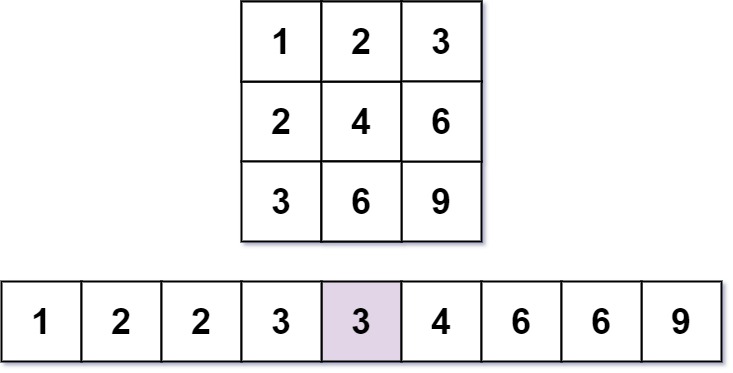
Input: m = 3, n = 3, k = 5Output: 3Explanation: The 5th smallest number is 3.Example 2:
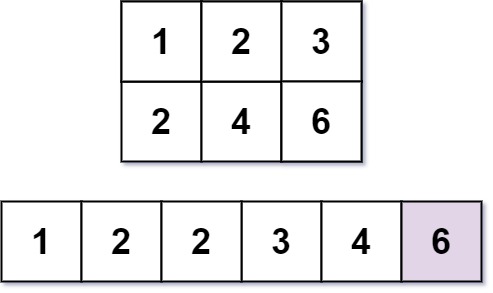
Input: m = 2, n = 3, k = 6Output: 6Explanation: The 6th smallest number is 6.Constraints:
1 <= m, n <= 3 * 1041 <= k <= m * n
class Solution: def findKthNumber(self, m: int, n: int, k: int) -> int: def count(x): cnt = 0 for i in range(1, m + 1): cnt += min(x // i, n) return cnt
l = 0 r = m * n while l <= r: mid = (l + r) // 2 if count(mid) >= k: r = mid - 1 else: l = mid + 1 return lclass Solution {public: int findKthNumber(int m, int n, int k) { int l = 0; int r = m * n;
// Capture external variables by reference using &. auto count = [&](int x) { int cnt = 0; for (int i = 1; i <= m; i++) { cnt += min(x / i, n); } return cnt; }; // <--- IMPORTANT: Do not forget the semicolon after the lambda definition!
while (l <= r) { int mid = l + (r - l) / 2; if (count(mid) >= k) { r = mid - 1; } else { l = mid + 1; } } return l; }};